
One More Thing
I've had those moments when I look at a particularly crowded stretch of my calendar and wonder what idiot agreed to all of this.
Unfortunately, I’ve met her. And still look her in the mirror every morning.
But here's the frustrating part: I usually can't point to one spectacularly bad decision that got me there. Most of the decisions were perfectly reasonable when I made them.
The project was worth taking on. The commitment seemed manageable. And sometimes the things occupying that crowded week were decisions I'd made months earlier, when that stretch of calendar still looked relatively empty.
Of course, it wasn't actually empty. I just hadn't filled it in yet.
We make commitments one at a time
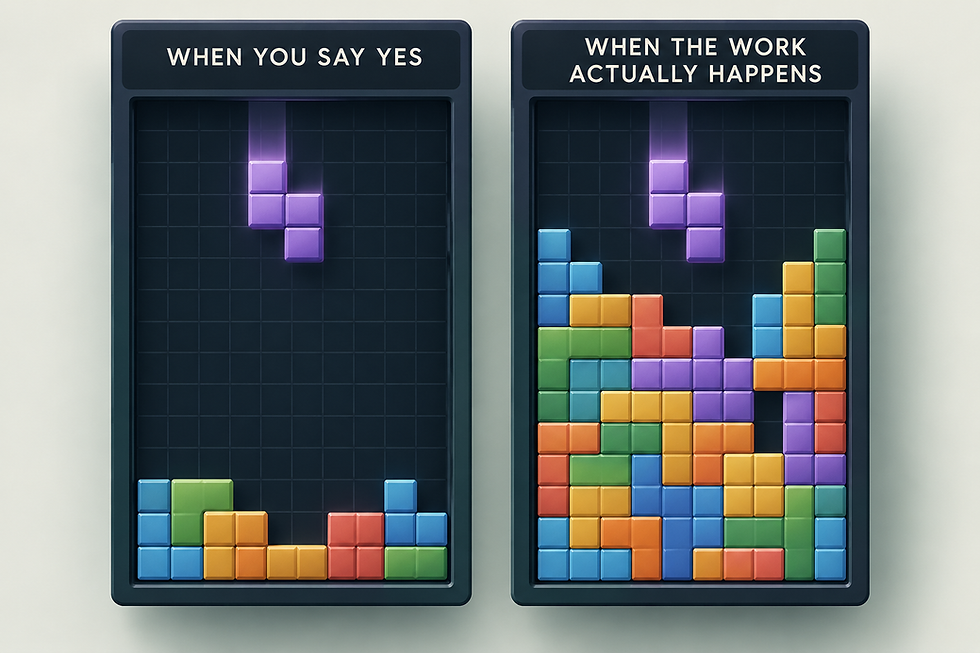
We make commitments one at a time. We experience them all at once.
Something that starts in October might seem perfectly manageable when we agree to it in May. By the time October arrives, circumstances have changed. New responsibilities have appeared. Something we expected to be finished isn't. Other perfectly reasonable decisions have landed in exactly the same place.
That doesn't necessarily mean the original decision was wrong. It means capacity isn't static—and some of our future capacity is already spoken for even when there's nothing on the calendar yet to prove it.
That's worth remembering when we're managing our own workloads. It's even more important when we're responsible for someone else's.
Ask a better question
When we want to give someone a new responsibility, it's tempting to ask:
Do you have time to take this on?
But that's asking for a judgment, not giving us much information.
Some people will tell you immediately when they're overloaded. Others will look at a truly unreasonable collection of commitments and think, Eh. I can make that work.
Hello, kettle.
Someone's willingness to say yes isn't necessarily evidence of capacity. So instead of asking them to assess whether they have "time," we can ask questions that make the workload itself more visible:
What else will be happening when this starts?
When is the heavy-lift period, and what else is happening then?
What have we already committed to that hasn't started yet?
What are we assuming will be finished by then, and how confident are we about that?
Those questions don't require someone to declare themselves overwhelmed. They give us a more objective picture of what the work will actually be landing on – and better information for whatever decision comes next.
When it still has to happen
Of course, seeing the capacity problem clearly doesn't mean we can always fix it.
Sometimes the deadline can't move. The resources aren't available. Nothing can come off the plate. There really is more work than comfortably fits.
Asking better questions doesn't magically create capacity. That's not a problem this post can neatly solve.
It does keep us from pretending we have capacity that isn't there. And it's better to see the gap clearly than to mistake someone's willingness to keep going for evidence that there was room for one more thing.
If the work needs to happen and existing capacity is tight, it's worth being explicit about what, if anything, can give. Sometimes that's the timeline, scope, resources or another responsibility. Or maybe we change what "good enough" looks like.
Define "good enough"
That doesn't mean advocating for bad work. It means recognizing that not every piece of work requires the maximum level of effort we're capable of giving it.
But telling someone who's already stretched thin that it doesn't have to be perfect isn't particularly helpful. They still have to decide what that means—and worry about whether you meant the same thing.
If circumstances require a different standard, help define it. What absolutely has to be right? What would we normally do that isn't necessary this time? At what point can the person doing the work legitimately call it finished?
Give people permission to stop at done – and make sure they know where done is.
The tradeoff doesn't disappear
There are times when all of us have to stretch. The important words there are times and stretch.
Sometimes a major deadline can't move or something unexpected happens, and for a short period we run a little harder than we normally would. The problem is when temporary heroics quietly become the capacity plan.
If the deadline can't move, the scope can't change, the standard can't change, nothing else can stop and no additional resources are available, we haven't eliminated the tradeoff.
We've simply decided where it will land.
Someone works more hours. Something gets rushed. Less visible work quietly doesn't happen. Or people find ways to make an unsustainable workload look surprisingly sustainable from the outside.
And that can make it awfully easy to add one more thing.
So before we ask Can we do this?, maybe we need to ask something different:
What will this be landing on?
If we don't decide what will absorb the cost, that doesn't mean there isn't one. It just means the decision gets made somewhere else.
One more thing rarely looks unreasonable by itself.
That's how we end up with so many of them.


Comments