
RealTalk Strategies: One Year Later
One year ago, I launched RealTalk Strategies.
Since then, the projects, clients, organizations, states, classrooms, conference rooms and Zoom screens have varied considerably.
The questions underneath the work? Surprisingly consistent.
I keep finding myself asking:
What problem are we actually trying to solve?
Do we all mean the same thing when we use that word?
Who owns this?
Do we have the capacity to do what we're committing to?
Will this actually work in real life, not just on paper?
Who ever thought this was a good idea?
(And, on too many occasions: Oh my God, why can't people read their email?)
A year ago, RealTalk was largely a theory: that there was value in helping leaders and organizations step outside the day-to-day long enough to see what was really happening, have some of the conversations underneath it, and move from good intentions to something that actually works.
I've learned there's another piece to that.
Sometimes organizations know they need to revisit the plan, fix the process, make the decision or tackle the thing that's been sitting on the list for months.
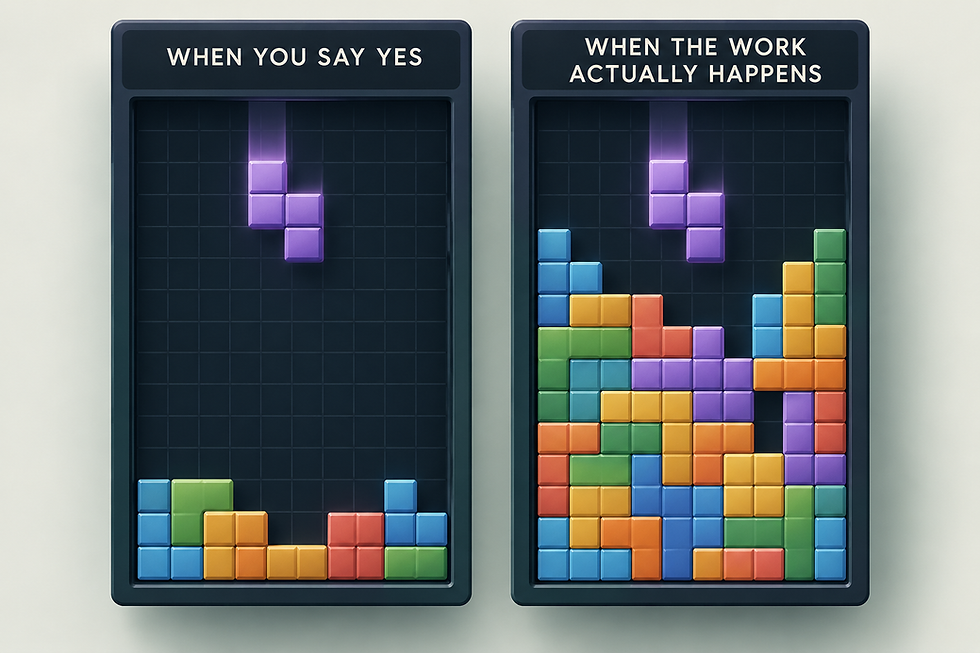
And then Tuesday happens. The inbox fills up. Someone needs an answer. The urgent steadily crowds out the important.
I've heard "We would never have gotten this far without you" enough times this year to recognize that sometimes the value of bringing in someone from outside isn't having someone else do the work. It's having someone whose job is to make sure the work gets done — creating the structure, asking the next question, keeping people engaged and making sure the important doesn't disappear again when Wednesday happens.
The view from outside is fascinating. But surprisingly no less maddening.
I've spent most of my career inside organizations. It turns out I really like being the person looking in from the outside.
There's something fascinating about learning how an organization actually works — how decisions get made, what history matters, where people see things differently and what everyone has quietly learned to work around.
Sometimes that makes a pattern surprisingly easy to see. The maddening part is that identifying it doesn't make it easy to fix.
You have to understand why things work the way they do. Ask questions. Listen. Test your assumptions. Understand what people are ready for. Help them create the solution and own it themselves.
That's where some of the most interesting work happens.
Unfortunately, I don't get a consultant exemption.
Spend enough time asking organizations questions about priorities, capacity, accountability and assumptions, and eventually some of those questions start whispering back.
I've warned organizations about adding priorities without talking about what will come off the list — while cheerfully adding another interesting project to my own.
I've written about rationalizing around our own guardrails, processes that work perfectly on paper, workarounds that don't solve the underlying problem, and the astonishing amount of work hiding behind the word just.
More than once, I've realized halfway through a Leading Out Loud post that I wasn't simply writing about something I'd observed. I was working something out for myself.
I thought this blog would be a place to share what I know. It has turned out to be one of the places where I figure out what I think and how that might be able to help someone else.
A year of evidence doesn't eliminate uncertainty.
People have trusted me with complicated questions and messy problems. They've invited me back, recommended me to others and told me the work helped.
I'm enormously proud of that.
And every new engagement still comes with a moment of wondering which parts of everything I've learned and experienced will matter most this time.
I've realized that confidence doesn't mean walking into every situation already knowing the answer. It's trusting that I know how to listen, ask the next question, make connections, challenge assumptions and help a group make sense of what it's seeing.
I've also gotten better at recognizing the difference between I haven't done this exact thing before and I'm not the right person for this work.
That feels like an important kind of confidence, too.
So, what about Year Two?
When I launched RealTalk, I thought leadership development would be at the center of the work. It's still work I love.
But I've discovered that I'm every bit as interested in what happens around the leader — the systems, culture, priorities, processes and people that determine whether good leadership can actually translate into organizational progress.
I'm at my best when an organization needs to move something forward but the path isn’t clear or simple — when there are competing priorities, different perspectives, unclear assumptions, capacity questions, or a need for someone outside the organization to help people see the whole picture and keep the work moving.
Year One hasn't given me a narrower definition of RealTalk. It has given me a clearer understanding of where I can be most useful.
My challenge for Year Two is to build intentionally around that: choosing the right opportunities, protecting the capacity to do them well, and building something useful to the people I serve and sustainable for me.
I suspect there will still be some anxiety involved.
Apparently, that's not a negotiable part of the business plan.
And mostly, thank you.
To the people who took a chance on a new business, trusted me with their organizations, recommended me and put some of their own credibility behind my name: thank you.
To the people who answered the phone, challenged my thinking, reassured me when I needed it and occasionally reminded me that no, I did not actually need to deal with that right now: thank you.
And to everyone who has read, commented on, shared or told me they recognized themselves in something I've written here: thank you.
A year ago, I had a theory, a lot of reasons to believe this could work — and absolutely no proof that it would.
A year later, I have experience, evidence — and still plenty of questions.
I'm looking forward to finding out what comes next.



Comments