
Unpack the Verb
I’ve developed a healthy suspicion of the word just.
We’ll “just” create a task force.
We’ll “just” send out a survey.
We’ll “just” start posting more on social media.
There may be no word in organizational life doing more unpaid labor than just. Because the thing that comes after it almost always sounds easy.
Create. Survey. Post. How hard could it be?
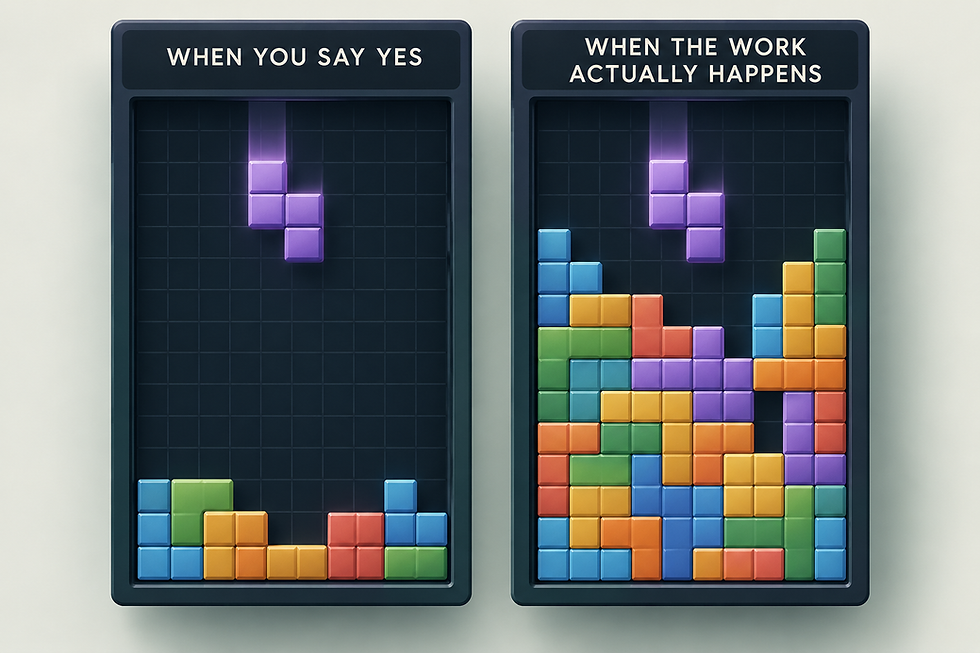
Well. There can be an astonishing amount of work hiding inside a single verb.
Take that, task force.
Someone has to figure out what it’s supposed to accomplish. Find a chair. Recruit members. Coordinate schedules. Prepare materials and agendas. Facilitate meetings. Follow up on assignments.
And eventually, someone is probably going to have to turn all of that into the fancy report everyone envisioned when someone first said, “Why don’t we just create a task force?”
None of this means creating the task force is a bad idea. It means the decision to create one took about 45 seconds. The work created by that decision didn’t.
Unpack the verb
Maybe my English degree is finally earning its keep, because I’ve started thinking that one of the most useful things leaders can do is unpack the verbs we use.
“We should survey our members.” What does survey actually require?
“We need to communicate more.” What does communicate require?
“Let’s track that.” Who collects the information? Where does it live? Who keeps it current? Who reports it? And presumably, at some point, someone is supposed to do something with it.
“We just need to post more on social media.” Someone still has to decide what we're trying to accomplish, come up with something worth saying, write it, create or find the visual, post it, pay attention to the response and then do it all over again a few days later.
It’s not a dissertation. But it’s also not just posting some things.
Sometimes something really is easy. Sometimes the way we’re doing it is more complicated than it needs to be. But we don’t know that just because it looks easy from where we’re sitting.
The view is different from inside the work
That matters, particularly when we’re making decisions about priorities, staffing and capacity.
A workplan – or a job description – can look remarkably manageable when complicated streams of work have been reduced to a handful of bullets.
Newsletter.
Member engagement.
Social media.
Committee support.
Financial management.
Five bullets. How long could that possibly take?
Except capacity isn’t determined by the number of bullets on a page. It’s determined by the work required to make each of them happen.
Maybe there’s a better process. Maybe technology could help. Maybe we're spending hours producing something nobody actually needs.
Those are good questions.
But there’s a difference between trying to understand why something takes eight hours and starting from the assumption that it couldn’t possibly take eight hours. Especially when the person actually doing it is telling us that it does.
And then there are all the other “justs”
Even if we understand the work inside one request, there's another problem.
Most of us are only adding one thing.
One board member wants the survey. Another wants the task force. The executive director wants more social media. A department head needs a new report. A client has one more small request.
Every one of them may be perfectly reasonable. But the person on the receiving end isn't doing any one of those things in isolation.
They're doing all the justs.
Adding a priority doesn’t add capacity. And calling something a priority doesn’t make the other priorities disappear.
So once we understand what the work actually requires, we have to be willing to let that information affect what happens next.
Sometimes the answer is more resources. Sometimes it’s a narrower scope, a longer timeline or a different approach.
And sometimes it means deciding that something else has to move. That sounds simple. It usually isn’t. “Just deprioritize something” can become its own version of just if we aren’t willing to hold that boundary when the supposedly lower-priority work comes wandering back to our desk demanding attention.
But that doesn't change the math.
We can add resources. Move the timeline. Change the scope. Find a different approach. Actually move something else. Or decide that this particular just isn't important enough to add after all.
What we can't do is keep stacking reasonable request on top of reasonable request and expect capacity to somehow expand to accommodate them:
“Well, this is important. We’ll just have to figure out how to make it happen.”
We’ll figure it out is not actually a resource. Or a strategy.
Sometimes making something happen really does take more than it looks like it should from where we're sitting.
And sometimes leadership means being willing to believe that – and make a different decision because of it.



Comments