
What Is My Presence Teaching People?
What is my presence teaching people?
It's not a question I'd ever really thought to ask myself until I found myself leading a meeting that felt... unusually quiet.
I expected ideas. Suggestions. Healthy debate.
Instead, people seemed to be waiting. For me.
At first, I wondered why the people responsible for the work weren't driving the discussion. Why wasn't anyone willing to offer an opinion or make a decision? Then it hit me.
For years, those conversations had always included the organization's leader. Their experience and perspective were genuinely valuable, and over time everyone had learned where the decision ultimately lived.
No one had ever actually said, "Wait for the leader to decide.” They didn't have to. The pattern had taught them.
And that’s when I understood – leaders don’t just make decisions. We teach people where decisions get made.
Not through speeches. Not through job descriptions. Through our repeated actions.
Every time we answer the question instead of asking one back.
When we step in to solve the problem.
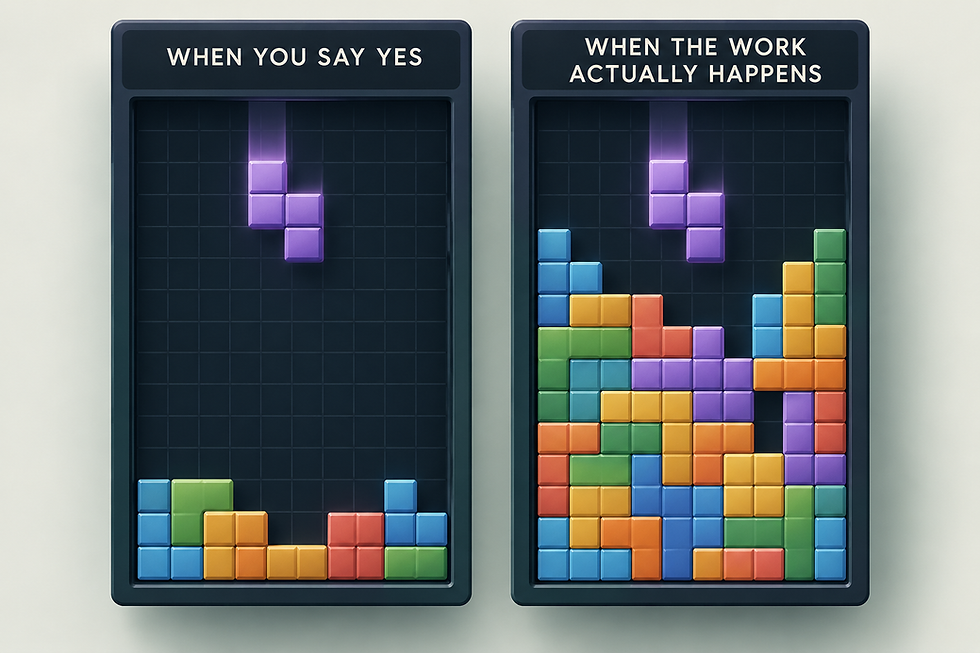
Or we volunteer to carry one more thing because it's easier than asking someone else to do it.
Or quietly absorb work we didn't want to put on someone else's shoulders.
None of those decisions are necessarily wrong. In fact, that’s what makes many of them so difficult. Many of them come from exactly the right place.
We don't want to overload our teams. We know someone is already stretched thin, and we know we can get it done quickly.
We tell ourselves we're helping.
How many times have we told our teams something like, "I don't want you working all weekend”? And then quietly spent our own weekend finishing the work we chose not to ask them to do.
It's so easy for leaders to reach a point of frustration: Why does every decision seem to end up on my desk? Why does it feel like I have to carry everything?
At some point those questions merge into one: How did this become my job?
But there's another question worth asking before we answer them:
What might I have done that helped create this pattern?
Not because every organizational problem is the leader's fault. It isn't.
Every culture is shaped by countless factors, and people are responsible for their own choices.
But leadership also means recognizing that our habits create and become part of the environment everyone else is responding to.
If I always make the final decision, people learn to wait.
When I step in every time something gets difficult, they begin to expect I'll eventually take it over.
And if I consistently shield everyone from the extra work, people may never have the opportunity to build the confidence that comes from carrying it themselves.
When we become the safety net for everything, we don't just take on more work—we lose the space to challenge whether all of that work is equally important in the first place.
Over time, everyone learns something.
The team learns: “The leader will eventually handle it.”
The leader learns: "Everything eventually becomes my responsibility."
We're doing more than solving today's problem. We're quietly, if unintentionally, normalizing tomorrow’s behavior.
That doesn't mean leaders should never step in.
Sometimes absorbing the extra work is exactly the right decision. Protecting your team is part of your job. Your experience really is needed in the room.
That’s why leadership requires judgment, not rigid rules.
The question isn't whether we ever help. The question is whether helping has become the pattern.
Which brings us back to where we started: What is my presence teaching people?
Am I creating confidence, or dependence?
Am I building a team that knows how to move forward without me, or one that has learned to wait until I arrive?
Those aren't comfortable questions, but they may be some of the most important ones we can ask ourselves as leaders.
Because over time, our teams don't just hear what we say.
They learn what "normal" looks like by watching what we repeatedly do.



Comments