
Who’s at the Table (And Who Isn’t)?
- Lisa Schaefer
- Apr 27
- 3 min read
I’ll be spending time this week talking about coalitions and stakeholder groups—how they start, why they matter and where they tend to go sideways.
But this isn’t just about coalitions.
These are the same challenge that show up when:
You’re pulling together a project team
Trying to get alignment across departments
Or figuring out who actually needs to be in the room for a decision
In other words…leadership.
Whether you call it a coalition, a project team or just “the people invited to the meeting,” there’s one place where things quietly fall apart:
Who’s at the table. And who isn’t. Or more accurately…how we decide who belongs there.
We Ask the Wrong Question
Most groups start here: “Who should be involved?”
It sounds reasonable. Responsible, even.
But it’s also where things start to get messy.
Because “should” quickly turns into:
Everyone who might care
Everyone we don’t want to leave out
Everyone who’s ever been part of something similar
And before long, you’ve got a full room, with no real clarity on why each person is there or what they’re supposed to do.
When roles are unclear, decisions slow down, ownership gets fuzzy and even strong teams struggle to make progress.
A Better Way to Think About It
Instead of asking who should be involved, try this:
Who actually needs to do the work—and who can help or block it?
Some people are in it day-to-day.
Others aren’t doing the work, but still have a say in whether it moves forward.
When you look at it this way, something shifts.
You stop trying to build the perfect group, and start building the right one.
Not Everyone Needs the Same Seat
Not everyone needs the same seat at the table.
And some people don’t need a seat at the table at all.
This is where a lot of groups get tripped up—treating everyone the same once they’ve been identified as “important.”
Instead, think about it like this:
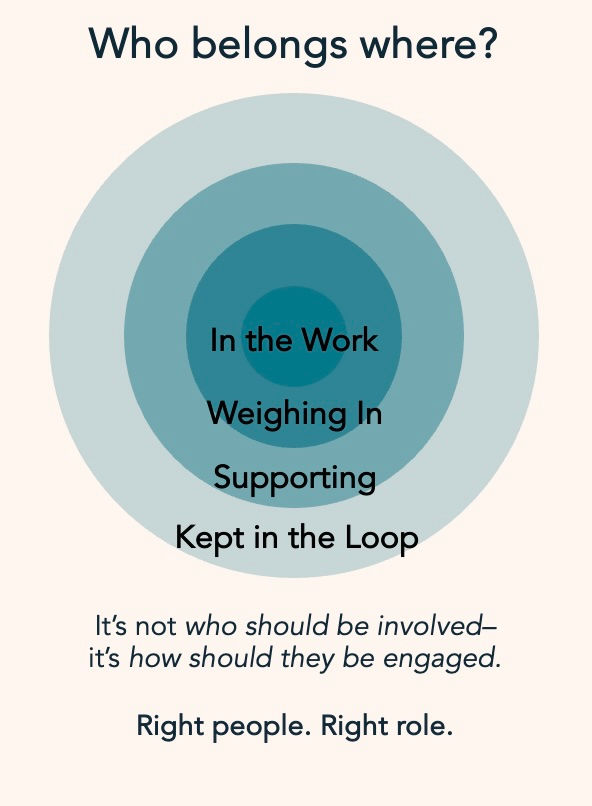
Some people need to be in the work - helping shape direction and move things forward
Some people need to be weighing in - offering input, perspective or expertise at key points
Some people are helpful, but not in the room - you engage them separately, without making them part of the core group
And some people just need to be kept in the loop - they don’t need to be part of every meeting or every decision, but they do need awareness
The goal isn’t to include everyone equally or to treat everyone the same.
It’s to engage the right people in the right way for the outcome you’re trying to achieve.
For newer leaders especially, this can feel uncomfortable—like you’re leaving people out. In reality, you’re helping everyone understand where they can contribute most.
The Part That Gets Overlooked
Even when people agree something matters, they don’t always agree on how to approach it.
And sometimes, bringing the “obvious” person into the group can actually make things harder
I’ve been in situations where:
the goals aligned
the person had influence
…but including them in the group would have complicated how the work was perceived—or slowed things down in ways that didn’t help.
So the question isn’t just “Do we agree?”
It’s:
Do we want the same outcome?
Can we actually work together?
How will this dynamic play out in the group?
Does this move us forward—or create friction?
You don’t need perfect alignment. But you do need to be honest about the trade-offs.
Where This Shows Up (Probably More Than You Think)
This isn’t just about formal coalitions.
It shows up anytime the work doesn’t sit neatly in one lane:
Cross-departmental projects
Committees or task forces
Leadership teams
Any meeting where you walk in and think, “Why are all of us here?”
Same dynamic. Different label.
A Simple Way to Pressure-Test Your Group
If you’re pulling a group together—or already in one that feels harder than it should—try this:
Think of 3–5 people involved in the work.
Then ask:
Do they need to be in the work, or just weigh in?
Are they helping move things forward—or unintentionally slowing things down?
What role actually makes sense for them?
Not:
“Should they be included?”
But:
“How should they be engaged?”
That one shift can save you a lot of frustration later.
Final Thought
Groups don’t usually struggle because people don’t care.
They struggle because we skip over the clarity needed to get started.
Who’s involved. Why they’re there. And what role they actually play.
You don’t need the perfect mix of people.
You just need a group that makes sense for the work you’re trying to do.


Comments